
 By
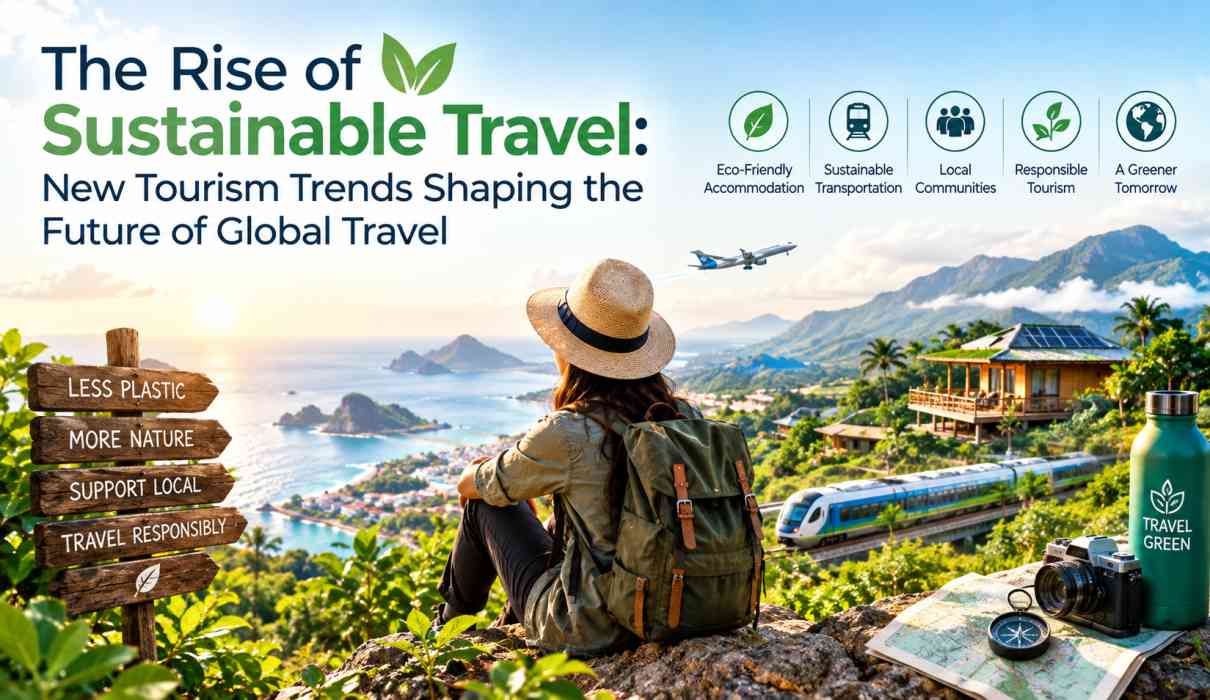
The Rise of Sustainable Travel: New Tourism Trends Shaping the Future of Global Travel
Travel is changing. While people continue to explore new countries, discover different cultures and enjoy unforgettable experiences, the way they think about travel is becoming more responsible. Environmental concerns, overtourism, climate change, local community needs and changing traveler expectations are encouraging the tourism industry to rethink how destinations are developed and visited.
This shift has made sustainable travel one of the most important trends shaping the future of global tourism.
Sustainable travel is no longer limited to choosing an eco-friendly hotel or carrying a reusable water bottle. It now includes how travelers reach destinations, where they stay, how long they stay, which communities benefit from their spending and how tourism affects natural and cultural environments.
The transformation is happening at a time when global tourism remains extremely strong. The World Economic Forum reports that international arrivals reached a record 1.5 billion in 2025, while travel and tourism contributed approximately $11.6 trillion to the global economy. At the same time, sustainability pressures are becoming more complex, including overcrowding, environmental stress and the unequal distribution of tourism benefits.
As tourism continues to grow, sustainable travel is becoming essential for creating destinations that remain attractive, healthy and economically valuable for future generations.
What Is Sustainable Travel?
Sustainable travel means exploring destinations while attempting to minimize negative environmental impacts and maximize benefits for local communities and economies.
It involves three major areas:
- Environmental responsibility: Reducing carbon emissions, waste, pollution and damage to ecosystems.
- Social responsibility: Respecting local cultures, communities, traditions and working conditions.
- Economic responsibility: Ensuring that tourism spending benefits local businesses, workers and destinations.
The goal is not to stop people from traveling. Instead, sustainable tourism aims to create a better balance between tourism growth and the long-term wellbeing of destinations.
The OECD’s 2026 tourism analysis emphasizes that tourism policies are increasingly focused on balancing economic, social and environmental outcomes while improving resilience and managing visitor pressures.
Why Sustainable Travel Is Becoming More Important
The rapid growth of tourism has created significant economic opportunities, but it has also created challenges.
Popular destinations can experience overcrowding, pressure on infrastructure, rising waste levels, increased demand for water and energy, and disruption to local communities. Climate-related events such as extreme heat, wildfires and other weather disruptions can also affect tourism infrastructure and traveler safety.
The tourism industry therefore faces an important question: How can global travel continue growing without damaging the destinations people want to visit?
The answer increasingly involves smarter destination management, responsible traveler behavior, sustainable infrastructure and stronger cooperation between governments, businesses and local communities.
Sustainable travel is becoming less about a single green initiative and more about creating a complete tourism ecosystem that can remain resilient over time.
1. Travelers Are Choosing Less-Crowded Destinations
One of the most important sustainable tourism trends is the growing interest in destinations beyond traditional tourist hotspots.
Instead of visiting the same famous cities and attractions during peak periods, travelers are increasingly exploring smaller towns, rural areas, emerging destinations and lesser-known cultural locations.
This approach can reduce pressure on overcrowded destinations while spreading tourism income to communities that may receive fewer visitors.
India provides a strong example of this direction. In September 2026, India’s Ministry of Tourism launched the National Mission for Alternative Destinations — Dekho Apna Desh 2.0, alongside the National Digital Tourism Stack, with an emphasis on taking tourism beyond popular destinations and creating opportunities for local communities.
This trend is likely to become increasingly important as destinations look for ways to manage visitor numbers while maintaining tourism revenue.
2. Off-Season Travel Is Becoming More Popular
Traveling during the off-season is another simple but powerful form of sustainable tourism.
Peak-season tourism can place enormous pressure on transportation, accommodation, attractions and natural resources. Visiting during quieter months can distribute tourist demand more evenly throughout the year.
For travelers, off-season travel can also provide advantages such as lower accommodation prices, fewer crowds and a more relaxed experience.
Destinations benefit because tourism businesses can maintain activity outside traditional peak periods, helping create more stable employment and income.
Rather than asking only, “Where should I travel?”, sustainable travelers are increasingly asking, “When should I travel to reduce pressure on the destination?”
3. Sustainable Transportation Is Reshaping Tourism
Transportation is one of the most important areas of sustainable travel.
Travelers are increasingly considering trains, public transportation, walking, cycling, electric vehicles and other lower-emission options when planning trips.
Rail travel is particularly attractive for some regional journeys because it can provide an alternative to short-haul flights. Within cities, public transportation and cycling can also reduce congestion and pollution.
At the same time, the aviation industry is working toward reducing its environmental impact. The World Economic Forum’s 2026 Global Aviation Sustainability Outlook highlights sustainable aviation fuel, airport transformation and market mechanisms such as book-and-claim as important parts of the industry’s path toward net-zero aviation.
Although aviation remains difficult to decarbonize, continued investment in cleaner fuels, more efficient aircraft and improved operations could significantly influence the future of sustainable travel.
4. Eco-Friendly Hotels Are Becoming the New Standard
Accommodation is another major part of sustainable tourism.
Hotels, resorts and vacation properties are increasingly investing in renewable energy, efficient lighting, smart climate control, water-saving systems, waste reduction and environmentally responsible construction.
Sustainable accommodation can include:
- Solar energy systems
- Energy-efficient appliances
- Water recycling
- Plastic reduction
- Locally sourced food
- Sustainable building materials
- Waste separation and recycling
- Eco-friendly cleaning products
- Smart energy management
However, travelers are becoming more interested in measurable sustainability rather than marketing claims alone.
This means tourism businesses will increasingly need to demonstrate what they are actually doing rather than simply describing themselves as “green.”
5. Local Communities Are Moving to the Center of Tourism
Sustainable travel is not only about protecting nature. It is also about improving the lives of people who live in tourism destinations.
Travelers increasingly want authentic experiences that allow them to interact with local communities, support local businesses and learn about regional traditions.
Buying from local artisans, eating at locally owned restaurants, staying in community-based accommodation and hiring local guides can help keep tourism revenue within the destination.
UNESCO and UN Tourism strengthened their cooperation in 2026 to promote tourism that is sustainable, inclusive and resilient, with a focus on protecting cultural and natural heritage, supporting communities and creating quality jobs.
This reflects a broader shift from tourism that simply brings visitors to a destination toward tourism that creates value for the destination itself.
6. AI Is Making Sustainable Travel Smarter
Artificial intelligence is becoming an important tool in the future of tourism.
AI can analyze large quantities of information to help travelers plan routes, identify less-crowded destinations, compare transportation options and personalize itineraries.
For tourism businesses and destination managers, AI can also help forecast visitor demand, manage crowds, optimize energy consumption and understand changing traveler behavior.
The OECD’s 2026 tourism report identifies digitalization and AI as opportunities for better tourism management, improved operational efficiency and more personalized experiences.
In the future, travelers may receive recommendations that consider not only price and convenience but also factors such as seasonality, congestion, environmental impact and local economic benefits.
This could make sustainability a natural part of trip planning rather than an additional decision travelers have to make.
7. Sustainable Food Tourism Is Growing
Food is an important part of travel, and it is also becoming an important part of sustainable tourism.
Local and seasonal food can reduce transportation requirements while supporting farmers, producers and restaurants within the destination.
Travelers are increasingly interested in farm-to-table restaurants, regional cuisines, local markets and authentic food experiences.
Reducing food waste is also becoming an important priority for hotels and restaurants. Businesses can use better demand forecasting, inventory management and smart technology to reduce unnecessary food consumption.
As travelers become more environmentally conscious, food experiences that connect visitors with local agriculture and culture are likely to become increasingly popular.
8. Nature-Based and Regenerative Travel Is Expanding
Sustainable tourism is moving beyond simply reducing harm toward the idea of regenerative travel.
Regenerative tourism aims to leave destinations stronger than they were before tourism activity occurred.
Examples can include supporting habitat restoration, participating in conservation projects, restoring local ecosystems or contributing directly to community development.
Nature-based tourism is also expanding as travelers seek hiking, wildlife experiences, national parks, forests, beaches and other natural environments.
However, responsible management is essential. A beautiful natural destination can quickly become damaged if visitor numbers exceed what its ecosystem can handle.
Future tourism planning will therefore need to balance access to nature with conservation.
9. Climate Resilience Will Become a Tourism Priority
Climate change is already influencing travel decisions.
Extreme heat, wildfires, storms, flooding and other weather events can affect destinations, transportation networks and tourism infrastructure.
This means sustainable tourism is increasingly connected with climate resilience.
Destinations may need to invest in heat-resistant infrastructure, improved water management, emergency planning, resilient transportation and better visitor communication.
The OECD’s 2026 tourism report specifically highlights the need for tourism destinations to strengthen their ability to adapt to extreme weather-related events.
In the future, a destination’s ability to remain safe and operational during climate-related disruptions could become just as important as its attractions.
10. Digital Tourism Is Supporting Responsible Travel
Digital technology is transforming how travelers discover and experience destinations.
Digital maps, mobile travel applications, online booking platforms, digital visitor passes and AI-powered travel assistants can make tourism more efficient.
Digital tools can also help destinations distribute visitors more effectively.
For example, an attraction could use real-time information to recommend alternative locations when visitor numbers become too high. Travelers could receive suggestions for nearby attractions, quieter travel periods or public transportation options.
India’s National Digital Tourism Stack is designed to make tourism offerings more discoverable, accessible and trustworthy while supporting a more connected tourism ecosystem.
This demonstrates how digital transformation and sustainable tourism can work together.
What Travelers Can Do to Travel More Sustainably
Sustainable tourism does not depend entirely on governments and large companies. Individual travelers also have an important role.
Simple choices can make a difference:
- Choose direct flights when flying is necessary.
- Use trains and public transportation where practical.
- Travel during less crowded periods.
- Visit lesser-known destinations.
- Stay in locally owned accommodation.
- Eat at local restaurants and buy local products.
- Avoid unnecessary single-use plastics.
- Respect local cultures and traditions.
- Follow environmental rules at natural attractions.
- Stay longer instead of taking frequent short trips when possible.
The objective is not perfection. Even small changes across millions of travelers can influence tourism demand and business practices.
The Future of Sustainable Travel
The future of tourism will likely combine technology, sustainability and personalization.
Travelers will increasingly expect booking platforms to provide information about environmental practices, transportation options, local experiences and destination conditions.
Hotels will continue investing in renewable energy and resource efficiency. Airlines will explore cleaner fuels and more efficient operations. Governments will introduce stronger visitor-management strategies. AI will help travelers and tourism organizations make better decisions.
At the same time, destinations will increasingly measure tourism success not only by the number of visitors but by the value those visitors create.
This represents a major change in the definition of tourism success.
More tourists do not automatically mean better tourism. A healthier model focuses on better experiences, stronger local economies, protected environments and resilient communities.
Conclusion
The rise of sustainable travel represents one of the biggest changes in the global tourism industry.
Travelers are becoming more aware of their environmental and social impact, while destinations and tourism businesses are recognizing that long-term success depends on protecting the places people want to visit.
From alternative destinations and off-season travel to sustainable transportation, eco-friendly hotels, local experiences, AI-powered planning and climate resilience, new tourism trends are creating a more responsible approach to exploring the world.
International tourism remains strong, but the next phase of growth will increasingly be about managing that demand responsibly. UN Tourism estimated around 690 million international tourists traveled during the first half of 2026, showing that global travel demand remains substantial even amid geopolitical and economic challenges.
Ultimately, sustainable travel is not about traveling less or giving up memorable experiences. It is about traveling better.
The future traveler will not simply ask where to go and what to see. They will also ask how their journey affects the environment, communities and culture around them.
That mindset could shape a more sustainable, inclusive and resilient future for global tourism.