
 By
Below is an SEO-focused article of approximately 1,900 words, incorporating current 2026 travel trends and supporting factual claims with recent sources.
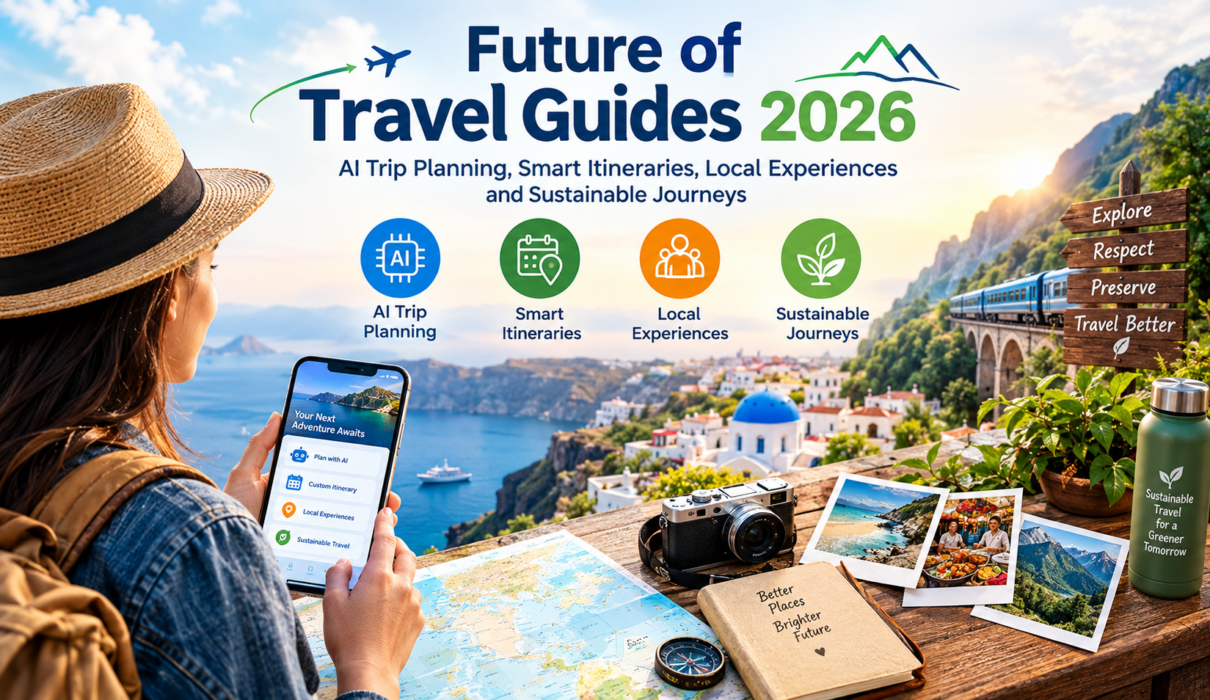
Future of Travel Guides 2026: AI Trip Planning, Smart Itineraries, Local Experiences and Sustainable Journeys
Travel guides have changed dramatically over the past decade. Traditional guidebooks once provided travelers with destination descriptions, maps, hotel recommendations, restaurant lists, and sightseeing suggestions. Today, travelers can access real-time information through smartphones, travel platforms, social media, digital maps, and artificial intelligence.
In 2026, the future of travel guides is becoming even more personalized and technology-driven. Artificial intelligence is helping travelers discover destinations, build itineraries, compare options, and find activities that match their interests. At the same time, travelers are increasingly interested in authentic local experiences, sustainable tourism, flexible journeys, and less crowded destinations.
This transformation does not mean traditional travel knowledge is becoming irrelevant. Instead, modern travel guides are combining reliable destination information with intelligent digital tools and personalized recommendations.
From AI trip planning and smart itineraries to sustainable journeys and local experiences, here are the major trends shaping travel guides in 2026.
AI Is Transforming Travel Guide Planning
Artificial intelligence has become one of the most important developments in modern travel planning. Instead of searching through dozens of websites, travelers can increasingly use AI-powered tools to describe their preferences and receive customized suggestions.
For example, a traveler can specify a budget, preferred travel dates, interests, accommodation preferences, dietary requirements, and desired activities. AI can then help organize potential destinations and create a preliminary itinerary.
This trend is particularly relevant in India. Agoda reported in May 2026 that 33% of surveyed Indian travelers already used AI for travel planning, while 68% said they were likely to use AI for their next trip.
AI can also help travelers discover restaurants, attractions, transportation options, and less obvious destinations. Research published by McKinsey in 2026 found that among travelers who had used generative AI for travel-related tasks, 84% reported that it improved their experience.
However, AI should be treated as a planning assistant rather than an unquestionable authority. Travelers should verify opening hours, transportation schedules, visa requirements, prices, weather information, safety guidance, and booking conditions through authoritative sources.
Smart Itineraries Are Replacing One-Size-Fits-All Guides
Traditional travel guides often provide fixed recommendations such as “top 10 attractions” or “three-day itinerary.” These can be useful, but modern travelers increasingly want plans that reflect their individual interests.
A smart itinerary can consider factors such as:
- Travel budget
- Trip duration
- Preferred activities
- Transportation options
- Family or group requirements
- Food preferences
- Weather conditions
- Accessibility needs
- Preferred travel pace
- Interests such as culture, nature, shopping, sports, or wellness
This allows travel guides to become more flexible.
For example, two people visiting the same city might receive completely different recommendations. One traveler may prefer museums and historical sites, while another may want local food, outdoor activities, and nightlife.
AI and data-driven travel technology are making this kind of personalization increasingly practical. The OECD’s 2026 tourism outlook notes that digital tools and AI are helping create more personalized services while supporting real-time visitor-flow management and destination planning.
Real-Time Travel Information Is Becoming Essential
A modern travel guide cannot simply provide information that was accurate several years ago. Travelers increasingly expect current information.
Weather, transportation, attraction schedules, prices, local events, road conditions, and travel regulations can change quickly. Digital travel guides can therefore provide a more useful experience when they connect travelers with regularly updated information.
Real-time technology can also help visitors adapt their plans. If a destination becomes crowded, an alternative attraction may be suggested. If heavy rain affects an outdoor activity, an indoor experience can be recommended instead.
This creates a more responsive form of travel planning.
The future travel guide is therefore likely to work less like a static book and more like a dynamic travel companion.
Local Experiences Are Becoming More Important
Travelers are increasingly interested in experiences that connect them with local communities and everyday culture.
Instead of visiting only famous landmarks, many travelers want to explore local food markets, neighborhood restaurants, workshops, cultural events, independent businesses, nature trails, festivals, and community-based activities.
This shift is reflected in the growing emphasis on local and interest-based experiences. TUI Musement’s 2026 travel trends identified local micro-adventures, city experiences, and personalized activities among notable travel trends.
For travel guides, this means destination content needs to go beyond famous attractions.
A useful modern guide can explain how to experience a destination respectfully, where local communities gather, which cultural traditions visitors can learn about, and how travelers can support independent businesses.
Hidden Destinations and Less-Crowded Places
Overtourism has become a major consideration for travelers and destination managers. Famous attractions can become extremely crowded during peak periods, affecting both visitor experiences and local communities.
As a result, travel guides are increasingly highlighting alternative destinations, quieter neighborhoods, regional towns, shoulder-season travel, and lesser-known attractions.
AI can potentially assist with this by analyzing large amounts of travel information and identifying alternatives based on traveler preferences. However, promoting lesser-known destinations also requires responsibility. Sending huge numbers of visitors to previously quiet locations can create the same overcrowding problem elsewhere.
Good travel guides should therefore provide context about visitor capacity, local rules, seasonal conditions, and responsible behavior.
Sustainable Travel Guides for 2026
Sustainability has moved from being a niche travel topic to a mainstream consideration.
Travelers are increasingly thinking about transportation, accommodation, waste, natural environments, local communities, and the overall impact of tourism.
Agoda’s 2026 Sustainable Travel Survey found that 77% of surveyed Asian travelers considered sustainability important when choosing travel options, while 88% of surveyed Indian respondents said sustainability was important.
Modern travel guides can support sustainable decisions by highlighting:
- Public transportation
- Walking and cycling routes
- Eco-conscious accommodations
- Local businesses
- Off-season travel
- Protected natural areas
- Responsible wildlife experiences
- Waste-reduction practices
- Community-based tourism
- Sustainable tours and activities
Sustainability is also evolving toward a broader idea of regenerative travel. Rather than simply reducing negative impacts, some tourism businesses and travelers are exploring ways to contribute positively to local communities and natural environments.
AI and Sustainable Tourism
Artificial intelligence may also contribute to more sustainable travel planning.
AI-powered systems can analyze visitor patterns and potentially recommend alternative routes, attractions, or travel times that reduce pressure on heavily visited locations.
A 2026 academic review of AI in sustainable tourism identifies applications including smart destination management, tailored travel planning, sustainable transportation, and visitor-flow optimization.
However, AI itself is not automatically sustainable. Digital infrastructure consumes energy and resources, and technology can create new environmental and social challenges.
The important point is that AI can become one tool within a wider sustainability strategy rather than a solution by itself.
Travel Guides Are Becoming More Visual
Photography, video, interactive maps, virtual tours, and short-form content are changing how people research destinations.
Travelers increasingly discover places through visual platforms and creator content before reading traditional destination articles. Google’s 2026 travel research for India highlights YouTube and Google as major touchpoints throughout the travel inspiration, research, planning, and booking journey.
This means modern travel guides need strong visual communication.
Useful content may include:
- Destination photographs
- Short videos
- Interactive maps
- Walking routes
- Transportation diagrams
- Neighborhood guides
- Restaurant and attraction visuals
- Seasonal travel imagery
- Short-form destination tips
Visual information can help travelers understand a destination before they arrive.
Mobile-First Travel Planning
Smartphones are now central to the travel experience.
Travelers use mobile devices for navigation, reservations, translation, communication, digital tickets, photography, payments, weather information, and travel research.
As a result, travel guides need to be easy to use on mobile devices.
Long articles should be structured with clear headings, short paragraphs, useful lists, maps, and quick-reference information. Important details such as transportation options, opening hours, estimated costs, and local tips should be easy to find.
The best digital travel guide is not necessarily the one with the most information. It is the one that presents useful information at the moment travelers need it.
Personalized Travel for Different Types of Travelers
The modern travel industry is becoming increasingly diverse. Travelers have different budgets, ages, interests, lifestyles, and expectations.
A family may prioritize child-friendly attractions and convenient transportation. Solo travelers may look for social experiences and flexible itineraries. Couples may prefer romantic destinations, while adventure travelers may want hiking, diving, cycling, or outdoor activities.
Business travelers may need efficient transportation and work-friendly accommodation, while wellness travelers may prioritize nature, relaxation, fitness, and healthy food.
Travel guides in 2026 can serve these different groups through personalized filters and recommendations rather than providing one generic list.
Domestic and Regional Travel Remain Important
International travel continues to attract attention, but domestic and regional travel remain important parts of the modern tourism landscape.
In India, Allianz Partners reported in June 2026 that 60% of surveyed Indian travelers planned to holiday within the country during the summer period covered by its study.
Domestic travel can offer advantages such as shorter journeys, easier planning, familiarity with local infrastructure, and opportunities to explore destinations within one’s own country.
This creates significant opportunities for travel guides covering cities, states, regions, weekend destinations, road trips, cultural sites, nature destinations, and local experiences.
Travel Safety and Practical Information
A high-quality travel guide should not focus exclusively on attractions.
Practical information is becoming increasingly important because travelers want to make informed decisions.
Useful sections can cover transportation, local laws, weather, travel documents, emergency contacts, insurance considerations, accessibility, payment methods, connectivity, and cultural etiquette.
This is particularly important as travelers face changing weather conditions, geopolitical uncertainty, and evolving border and entry requirements.
Current information should always be checked against official government or destination sources before travelers make important decisions.
The Future of Travel Guides Is Human and Digital
Although AI is transforming travel planning, human expertise remains valuable.
AI can process information quickly, but local knowledge can provide context that automated systems may miss. A local writer can explain why a neighborhood is special, how a cultural event is experienced, which local customs matter, or why a particular route is worth taking.
The most effective future travel guides are therefore likely to combine technology with human insight.
AI can handle personalization, organization, search, and itinerary suggestions, while experienced writers, local experts, tourism professionals, and travelers can contribute context, authenticity, and practical knowledge.
How Travelers Can Use AI Responsibly
AI can make trip planning easier, but travelers should use it carefully.
A practical approach is to use AI for inspiration and itinerary creation, then verify important information through official and trusted sources.
Travelers should double-check:
- Visa and passport requirements
- Entry regulations
- Flight and train schedules
- Hotel and attraction availability
- Prices and cancellation policies
- Weather forecasts
- Health and safety guidance
- Local transportation
- Travel insurance requirements
- Local laws and cultural rules
This combination of AI convenience and human verification can make travel planning more reliable.
Conclusion
The future of travel guides in 2026 is becoming smarter, more personalized, visual, sustainable, and experience-focused.
AI trip planning is helping travelers discover destinations and build customized itineraries. Mobile technology is making travel information available almost everywhere. Local experiences are becoming more important as travelers look beyond famous attractions, while sustainable tourism is influencing destination and activity choices.
At the same time, traditional travel expertise remains valuable. Technology can organize information, but meaningful travel depends on culture, people, places, and personal experiences.
The travel guide of the future will therefore not simply tell people where to go. It will help them understand why to go, when to go, how to travel responsibly, what to experience, and how to adapt their journey to their own interests.
As AI, real-time data, mobile technology, and sustainable tourism continue to develop, travel guides are evolving from static sources of information into intelligent digital companions. For travelers, this means more personalized choices and potentially better experiences. For destinations and tourism businesses, it creates new opportunities to connect visitors with authentic experiences while encouraging more responsible and sustainable travel.