
 By
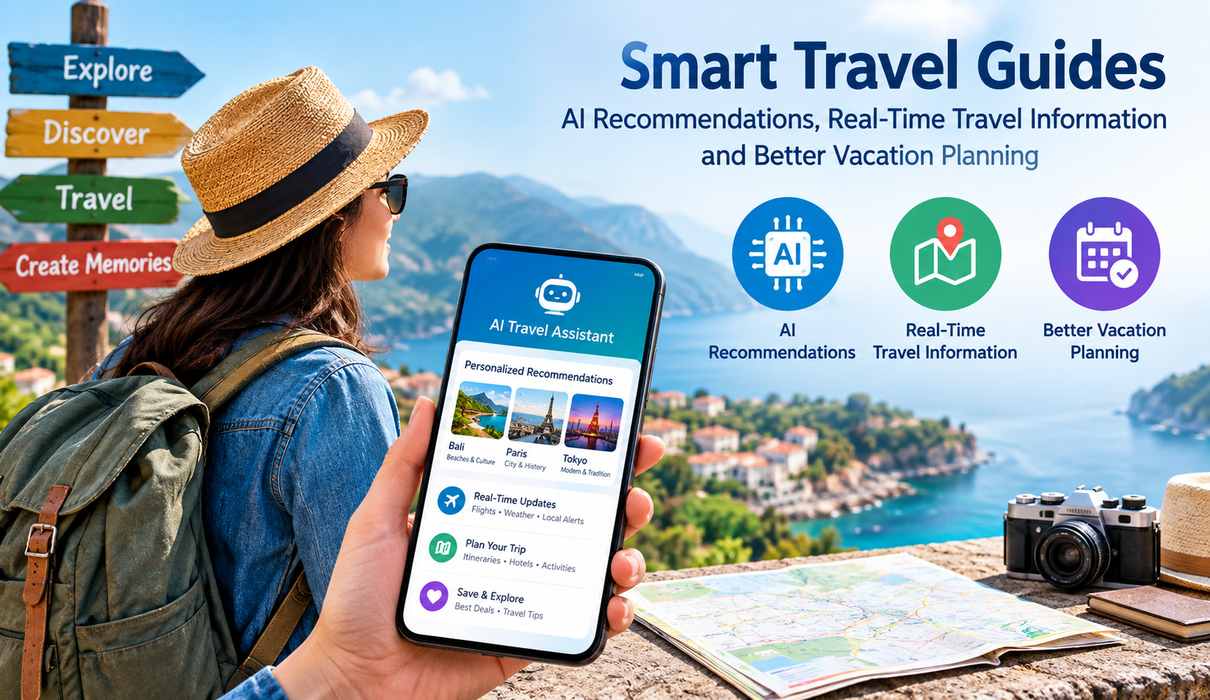
Smart Travel Guides: AI Recommendations, Real-Time Travel Information and Better Vacation Planning
Travel planning is changing rapidly as technology becomes a larger part of the way people discover destinations, organize trips and make decisions while travelling. Traditional travel guides remain useful, but modern travellers increasingly expect more than lists of attractions, hotel suggestions and basic destination information. They want recommendations that match their interests, real-time updates, flexible itineraries and practical information that can help them make better decisions throughout their journey.
This is where smart travel guides are becoming increasingly important. By combining artificial intelligence, real-time information, digital maps, personalized recommendations and mobile technology, modern travel guides can provide a more flexible and useful travel-planning experience.
Instead of following a fixed itinerary, travellers can use digital tools to adjust plans according to weather, opening hours, transportation conditions, budgets, interests and available time. AI-powered recommendations can also help identify restaurants, attractions, activities and destinations that fit individual preferences.
What Are Smart Travel Guides?
Smart travel guides are digital travel resources that use modern technologies to provide personalized and frequently updated information to travellers. They can exist as mobile applications, websites, digital assistants, interactive maps or integrated travel platforms.
Traditional travel guides generally provide information that remains relatively static. A smart travel guide can respond to changing conditions and user preferences.
For example, a traveller visiting a city may ask a digital travel assistant to create a one-day itinerary focused on museums, local food and walking experiences. The system can organize destinations geographically, consider opening times and suggest transportation options.
If heavy rain is forecast, the itinerary can potentially be adjusted to prioritize indoor attractions. If a museum is temporarily closed, another activity can be recommended.
This combination of personalization and real-time information makes smart travel guides particularly valuable for modern travellers.
AI-Powered Travel Recommendations
One of the most significant developments in modern travel planning is the use of artificial intelligence.
AI systems can analyze information about a traveller’s interests, budget, preferred activities, travel dates and destination to generate personalized suggestions.
A traveller interested in history may receive recommendations for museums, heritage sites and historical walking tours. Someone interested in food may receive suggestions for markets, restaurants, cooking experiences and local food districts.
AI can also help travellers discover activities beyond the most commonly promoted attractions. Instead of simply showing the most popular destinations, recommendation systems can organize suggestions around specific interests.
For example, a traveller could request:
- Affordable family activities
- Romantic places for couples
- Quiet destinations away from crowds
- Local cultural experiences
- Vegetarian-friendly restaurants
- Outdoor adventures
- Photography locations
- Short activities between flights
- Attractions suitable for children
This makes travel discovery more personalized and reduces the amount of time required to search through multiple websites.
Real-Time Travel Information
Travel conditions can change quickly. Weather, transportation schedules, attraction availability, traffic conditions and local events can all affect a travel itinerary.
Smart travel guides can help travellers respond to these changes by providing access to current information.
For example, real-time travel information can help users identify transportation disruptions, changing weather conditions or temporary attraction closures. A traveller can then adjust plans instead of discovering the problem after arriving.
Real-time information can also be valuable during airport transfers, road trips and public transportation journeys. Digital maps and navigation services can help travellers understand routes, estimated travel times and alternative transportation options.
The result is a more flexible travel experience in which plans can evolve instead of remaining fixed.
Personalized Itineraries for Better Vacation Planning
Creating an itinerary can be one of the most time-consuming parts of planning a vacation. Travellers often need to compare attractions, transportation, restaurants, hotels and activities before deciding how to organize each day.
Smart travel guides can simplify this process.
An AI-powered system can create an itinerary based on factors such as:
- Destination
- Travel dates
- Budget
- Interests
- Group size
- Preferred transportation
- Activity level
- Available time
- Food preferences
A traveller visiting a major city for three days could receive a structured schedule that groups nearby attractions together and leaves sufficient time for meals and transportation.
This can make the itinerary more practical than simply creating a long list of places to visit.
Smart itinerary planning can also reduce unnecessary travel between locations. Grouping attractions by neighborhood or geographical area can help travellers spend more time exploring and less time commuting.
Smart Maps and Location-Based Travel Assistance
Digital maps have already transformed the way people navigate unfamiliar destinations. Smart travel technology is taking this concept further by combining maps with personalized recommendations and local information.
A smart travel map can display attractions, restaurants, hotels, transportation points and activities according to a traveller’s interests.
Location-based recommendations can also help travellers discover nearby experiences.
For example, while walking through a city, a traveller might receive information about a nearby historic building, market or cultural attraction. Instead of relying entirely on pre-planned destinations, travellers can discover experiences as they explore.
Digital maps can also help organize routes, estimate travel times and identify nearby services.
This makes navigation an important part of the modern travel guide experience.
Discovering Local Experiences
Modern travellers are increasingly interested in authentic local experiences rather than simply visiting famous tourist attractions.
Smart travel guides can help connect travellers with local culture through recommendations for markets, neighborhood restaurants, festivals, workshops, cultural events and community experiences.
For example, instead of only recommending a famous restaurant, a travel guide might introduce a local food market or cooking class.
This can help travellers explore destinations from different perspectives.
Local experiences can also support smaller businesses and tourism providers by helping travellers discover services that may not have the same visibility as major international brands.
Sustainable Travel Planning
Sustainability is another important consideration in modern tourism.
Smart travel guides can support more responsible travel by highlighting public transportation, walking routes, cycling opportunities, eco-friendly accommodation and locally operated experiences.
Travel planning technology can also help users compare different transportation options.
For short distances, walking or cycling may be practical alternatives to private transportation. For longer journeys, rail or public transportation may provide another option depending on the destination.
Smart guides can make these alternatives easier to discover by incorporating them into travel planning rather than treating sustainability as a separate consideration.
Budget-Friendly Vacation Planning
Travel budgets vary considerably between individuals and families. A useful travel guide therefore needs to support different spending levels.
AI-powered travel recommendations can help travellers organize trips around a defined budget.
For example, users may search for:
- Affordable accommodation
- Free attractions
- Low-cost transportation
- Budget restaurants
- Discounted activities
- Affordable destinations
- Short weekend trips
Smart planning can also help travellers understand how different choices affect the overall cost of a trip.
Instead of simply selecting the most popular hotel or attraction, users can compare options according to price, location and personal preferences.
This can make travel planning more transparent and practical.
AI and Multilingual Travel Assistance
Language can be a major challenge when travelling internationally.
Modern digital travel tools can provide translation assistance, destination information and communication support in multiple languages.
Travellers can use AI-powered language tools to understand menus, signs, transportation instructions and basic local communication.
This can be particularly helpful in destinations where travellers do not speak the local language.
Multilingual travel assistance can also make destination information more accessible to a wider global audience.
Smart Travel Guides for Families
Family travel often requires additional planning because different age groups may have different needs.
Parents may need to consider child-friendly attractions, meal options, transportation, rest periods and accommodation.
Smart travel guides can help organize activities according to the needs of the entire group.
For example, an itinerary can combine educational attractions with entertainment, outdoor activities and suitable meal breaks.
Parents can also search for attractions based on age suitability and accessibility requirements.
This can make family vacation planning more organized and reduce the amount of manual research required.
Improving Accessibility in Travel
Technology also has the potential to make travel information more accessible.
Travellers with mobility limitations or other accessibility requirements may need information about elevators, accessible transportation, step-free entrances, suitable accommodation and accessible attractions.
Smart travel platforms can make it easier to search for these features when information is available.
Accessibility-focused travel planning can help users identify suitable locations before they arrive, allowing them to prepare more effectively.
As digital travel services continue to develop, providing accurate and detailed accessibility information can become an increasingly important part of travel planning.
The Role of Mobile Technology
Smartphones have become central to modern travel.
Travellers can use a single device for navigation, reservations, digital tickets, translation, communication, payments and travel information.
This makes mobile travel guides particularly convenient.
Instead of carrying multiple printed guides and documents, travellers can access their itinerary and important information through a mobile device.
Mobile technology can also support notifications about schedule changes, transportation updates and reservations.
The combination of smartphones, GPS, digital maps and AI creates a highly connected travel experience.
Privacy and Accuracy Challenges
Despite the benefits of smart travel guides, travellers should also consider their limitations.
AI-generated recommendations may not always be accurate or up to date. Businesses can change their opening hours, prices and availability. Events may be cancelled, transportation schedules may change and weather forecasts can evolve.
Travellers should therefore verify important information through official sources, especially for flights, visas, entry requirements, reservations and transportation.
Privacy is another consideration. Personalized recommendations may require information about location, preferences or travel behavior.
Travel platforms should provide clear information about how user data is collected and used. Travellers should review privacy settings and avoid sharing unnecessary personal information.
The Future of Smart Travel Guides
The future of travel guides is likely to become increasingly personalized, interactive and connected.
Artificial intelligence may help travellers create complete journeys based on natural-language requests. Instead of searching individually for hotels, attractions, restaurants and transportation, users may be able to describe the type of trip they want and receive an organized travel plan.
Wearable devices and augmented reality could also provide contextual information while travellers explore destinations.
For example, smart glasses could potentially display information about landmarks or directions without requiring users to constantly look at their phones.
Real-time data, AI recommendations and digital maps may also become more closely integrated with booking and transportation services.
However, technology is unlikely to replace the value of human curiosity and local discovery. The most useful travel tools will probably combine automation with opportunities for travellers to explore independently.
How to Use Smart Travel Guides Effectively
Travellers can get better results from smart travel tools by providing clear information about their preferences.
Instead of asking for a general itinerary, users can specify:
- Destination and travel dates
- Number of travellers
- Budget range
- Preferred activities
- Dietary requirements
- Transportation preferences
- Desired travel pace
- Accessibility requirements
- Must-see attractions
- Experiences they want to avoid
It is also useful to verify important recommendations before making bookings.
AI can be an excellent planning assistant, but travellers should continue to use official tourism websites, transportation providers, airlines, hotels and attraction websites for critical information.
Conclusion
Smart travel guides are transforming the way people plan and experience vacations. AI recommendations, real-time travel information, digital maps, personalized itineraries and mobile technology are making travel planning more flexible and convenient.
From discovering local experiences and managing budgets to adapting itineraries according to changing conditions, modern travel technology can reduce the complexity of organizing a trip.
The most effective approach is to use smart travel guides as planning and discovery tools while verifying important details through reliable official sources. As artificial intelligence and connected travel technologies continue to develop, digital travel guides will become increasingly personalized and responsive.
For travellers, the future of vacation planning is not simply about having more information. It is about having the right information at the right time, presented in a way that helps turn travel ideas into practical, enjoyable and memorable journeys.