
 By
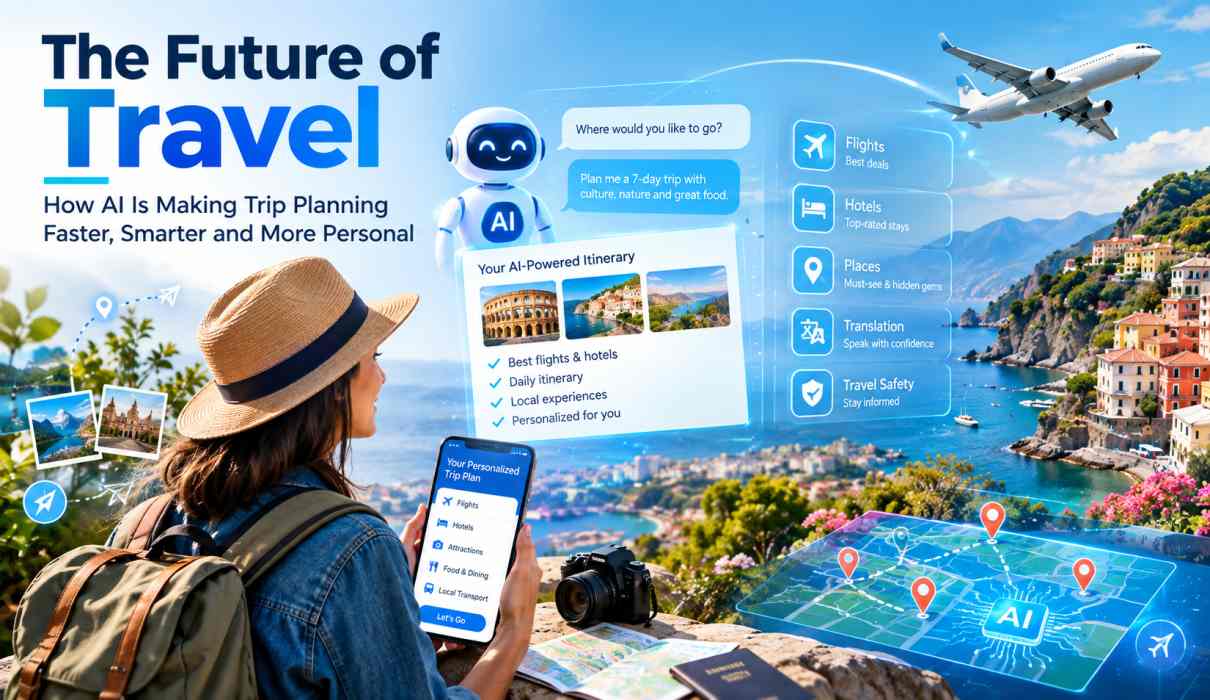
The Future of Travel: How AI Is Making Trip Planning Faster, Smarter and More Personal
Planning a trip used to involve hours of research, comparing flights, checking hotel reviews, creating itineraries, finding attractions and figuring out transportation. Today, artificial intelligence (AI) is changing that process by making travel planning faster, more personalized and increasingly convenient.
From recommending destinations to building complete itineraries, AI-powered travel tools can analyze large amounts of information and turn it into useful suggestions. Travelers can now use technology to discover places, compare options, organize schedules, translate languages and receive assistance during their journeys.
The future of travel is not simply about booking a flight or hotel online. It is about creating a personalized travel experience based on individual preferences, budgets, interests and schedules.
As AI technology continues to develop, travelers can expect trip planning to become more automated while still leaving important decisions in human hands.
1. AI Is Changing the Way People Plan Trips
Traditional travel planning often requires visiting multiple websites and apps. Travelers may search for destinations on one platform, compare flights somewhere else, read hotel reviews on another website and manually build an itinerary.
AI can bring many of these tasks together.
Instead of searching for individual pieces of information, travelers can describe what they want in natural language. For example, someone might ask for a seven-day trip that includes cultural attractions, local food, outdoor activities and affordable accommodation.
An AI-powered travel assistant can use these preferences to suggest destinations and create a starting itinerary.
This can significantly reduce the amount of time spent researching.
AI does not remove the need for human judgment. Travelers still need to verify prices, opening hours, visa requirements, transportation details and other important information. However, AI can make the initial research process much more efficient.
2. Personalized Travel Recommendations
One of the biggest advantages of AI in travel is personalization.
Traditional travel recommendations often provide the same popular destinations to large numbers of travelers. AI can potentially create recommendations based on individual preferences.
For example, a traveler who enjoys museums and historical architecture may receive different suggestions from someone who prefers beaches, hiking and adventure activities.
AI systems can consider factors such as:
- Travel budget
- Preferred destinations
- Trip duration
- Interests and hobbies
- Food preferences
- Preferred accommodation
- Travel style
- Family or solo travel
- Weather preferences
- Previous travel behavior
This can make destination discovery more relevant.
Instead of asking, “What are the most popular places to visit?” travelers can increasingly ask, “Which destinations match the kind of experience I want?”
That shift from general recommendations to personalized travel planning could become one of the defining trends of modern tourism.
3. AI-Powered Itinerary Planning
Creating an itinerary can be one of the most time-consuming parts of travel planning.
A destination may have dozens of attractions, restaurants, museums and activities. The challenge is deciding what can realistically fit into a single day.
AI can help organize these choices.
A travel planning system can consider location, opening times, estimated visit duration and transportation time when creating an itinerary.
For example, instead of recommending attractions randomly, an AI system could group nearby locations together to reduce unnecessary travel.
A three-day city itinerary might include historical attractions on one day, museums and cultural sites on another, and food and shopping experiences on the final day.
Travelers can then modify the suggested schedule based on their preferences.
This makes AI particularly useful as a travel itinerary planner, especially for people who want a structured trip without spending hours creating the schedule themselves.
4. Smarter Flight and Hotel Research
Finding suitable flights and accommodation can also involve extensive comparison.
Travelers usually consider price, location, travel time, cancellation policies, ratings and amenities before making a booking.
AI can help organize these factors and present relevant choices.
Instead of focusing only on the cheapest option, AI-powered systems can potentially help travelers compare options based on their overall requirements.
For example, a slightly more expensive hotel might be a better fit if it is closer to major attractions and reduces transportation costs.
Similarly, a flight with a slightly higher fare could offer a more convenient schedule.
The value of AI is therefore not simply finding the lowest price. It can help travelers evaluate multiple factors simultaneously.
However, travelers should always confirm the final price, availability, cancellation rules and booking conditions directly with the airline, hotel or booking provider before making a purchase.
5. AI Is Making Travel More Accessible
Travel can sometimes be challenging for people with specific accessibility requirements.
AI-powered planning tools may help travelers identify accommodation, transportation and attractions that better match their needs.
For example, a traveler may request hotels with accessible entrances, elevators or adapted facilities. An AI assistant can help organize these requirements into a search or planning checklist.
Travelers should still verify accessibility information directly with service providers because facilities and policies can change.
Nevertheless, better digital planning can make it easier for travelers to identify relevant options before leaving home.
6. Language Translation Is Becoming Easier
Language barriers have traditionally been one of the biggest challenges when traveling internationally.
Modern AI-powered translation tools can translate text, speech and conversations across multiple languages.
Travelers can use these technologies to understand menus, signs, transportation information and basic conversations.
AI translation can be particularly useful in situations where travelers need quick assistance.
However, automated translation may not always understand local expressions, cultural context or specialized terminology perfectly. Important conversations involving legal, medical or official information should be handled carefully and verified when necessary.
Even with these limitations, AI is making communication easier for international travelers.
7. AI Travel Assistants Can Support Travelers During a Trip
AI can be useful after the planning stage as well.
A digital travel assistant can help travelers find nearby attractions, answer questions, reorganize an itinerary or provide suggestions when plans change.
For example, if heavy rain affects an outdoor activity, a traveler could ask an AI assistant to suggest indoor alternatives nearby.
Similarly, if a flight is delayed, travelers may use digital tools to reconsider transportation or adjust their schedules.
This creates a more flexible approach to travel.
Instead of following a fixed itinerary from beginning to end, travelers can make changes as circumstances develop.
8. AI Can Help Travelers Manage Their Budgets
Travel costs can increase quickly when flights, accommodation, food, transportation and activities are combined.
AI can help travelers create a more detailed travel budget before departure.
A planning system could divide estimated expenses into categories such as:
- Flights
- Accommodation
- Local transportation
- Food
- Attractions
- Shopping
- Travel insurance
- Emergency expenses
Travelers can then adjust their plans according to their available budget.
For example, someone with a limited budget might choose public transportation, affordable accommodation and free attractions. Another traveler might prioritize premium hotels and private transportation.
AI can make these trade-offs easier to visualize.
It is important to remember that AI-generated cost estimates are estimates. Actual prices can change based on dates, demand, location and availability.
9. AI Is Changing the Hotel Experience
The impact of AI is also becoming visible inside hotels.
Hotels can use technology to personalize guest experiences, automate certain services and improve operational efficiency.
AI-powered chatbots can answer common questions, while digital systems can help guests request services or obtain information about facilities.
Some hotels are also exploring smart-room technology that allows guests to control lighting, temperature and entertainment through connected devices.
The objective is to make the guest experience more convenient while allowing hotel employees to focus on more complex customer needs.
10. AI and Sustainable Travel
Technology may also support more responsible tourism.
Travelers increasingly want to understand the environmental impact of their journeys. AI could help compare transportation options and identify alternatives that may reduce unnecessary travel.
For example, a planning system could compare different transportation combinations rather than automatically recommending the fastest route.
AI can also help tourism businesses analyze demand and manage resources more efficiently.
However, technology alone cannot make tourism sustainable. Travelers, businesses and governments all play important roles in reducing environmental impact and protecting destinations.
11. AI Can Help With Travel Safety
Travel safety is another area where digital technology can provide useful assistance.
AI-powered systems can help travelers organize important information such as emergency contacts, local transportation options and destination-specific travel information.
Some applications can provide alerts about weather conditions or disruptions.
AI may also help travelers identify potential problems with an itinerary, such as overly tight connections or unrealistic travel schedules.
However, travelers should not depend entirely on AI for safety-related decisions. Official government travel advisories, local authorities, airlines and other trusted sources should remain important sources of current information.
12. The Rise of Conversational Travel Planning
One of the most interesting changes in travel technology is the move from traditional search to conversational planning.
Instead of entering dozens of keywords into search engines, travelers can interact with an AI assistant using natural language.
For example:
“I have five days, want to visit historical sites, prefer boutique hotels and have a moderate budget.”
The AI can use those requirements to create a starting point.
Travelers can then refine the request:
“Make the itinerary less busy.”
“Add more local food experiences.”
“Reduce transportation time.”
“Give me alternatives if it rains.”
This creates a more interactive travel planning experience.
13. Challenges of Using AI for Travel
Despite its benefits, AI travel planning has limitations.
Incorrect Information
AI systems can sometimes provide outdated or inaccurate information. Travelers should verify important details before making decisions.
Privacy
Personalized travel services may require information about preferences, locations or previous searches. Travelers should understand how their data is collected and used.
Over-Personalization
Too much personalization could limit discovery. Travelers may repeatedly receive recommendations similar to what they already know instead of discovering something unexpected.
Dependence on Technology
Travelers should not rely entirely on digital tools. Internet access, battery life and software availability can vary, especially in remote destinations.
Human judgment remains essential.
14. The Future of AI-Powered Travel
The next generation of travel technology is likely to become even more integrated.
AI could eventually connect different parts of a journey—from destination discovery and booking to transportation, accommodation and activities.
Travelers may have digital assistants that continuously monitor their itinerary and provide relevant updates.
Imagine arriving at an airport and receiving an automatically organized travel plan that considers your flight status, transportation options, hotel check-in and scheduled activities.
If something changes, the system could suggest alternatives.
The future of travel planning is therefore likely to become more dynamic rather than simply automated.
Conclusion: A More Intelligent Way to Travel
Artificial intelligence is changing travel by making trip planning faster, smarter and more personal.
From personalized destination recommendations and AI itinerary planning to translation, budgeting, hotel services and real-time travel assistance, technology is becoming an increasingly important part of the travel experience.
The biggest advantage of AI is its ability to process large amounts of information and turn that information into useful suggestions. Travelers can spend less time searching and more time enjoying their journeys.
At the same time, AI should be treated as a planning and decision-support tool rather than an unquestionable source of truth. Prices, schedules, entry requirements, weather conditions and local policies can change, so important information should always be verified through reliable and official sources.
Ultimately, the future of travel is likely to combine artificial intelligence with human curiosity and judgment. AI can help create the plan, discover possibilities and respond to changes, while travelers remain in control of where they go, what they experience and how they explore the world.
As technology continues to evolve, travel planning may become less about searching through endless information and more about simply describing the experience you want—and letting intelligent tools help turn that idea into a practical journey.