
 By
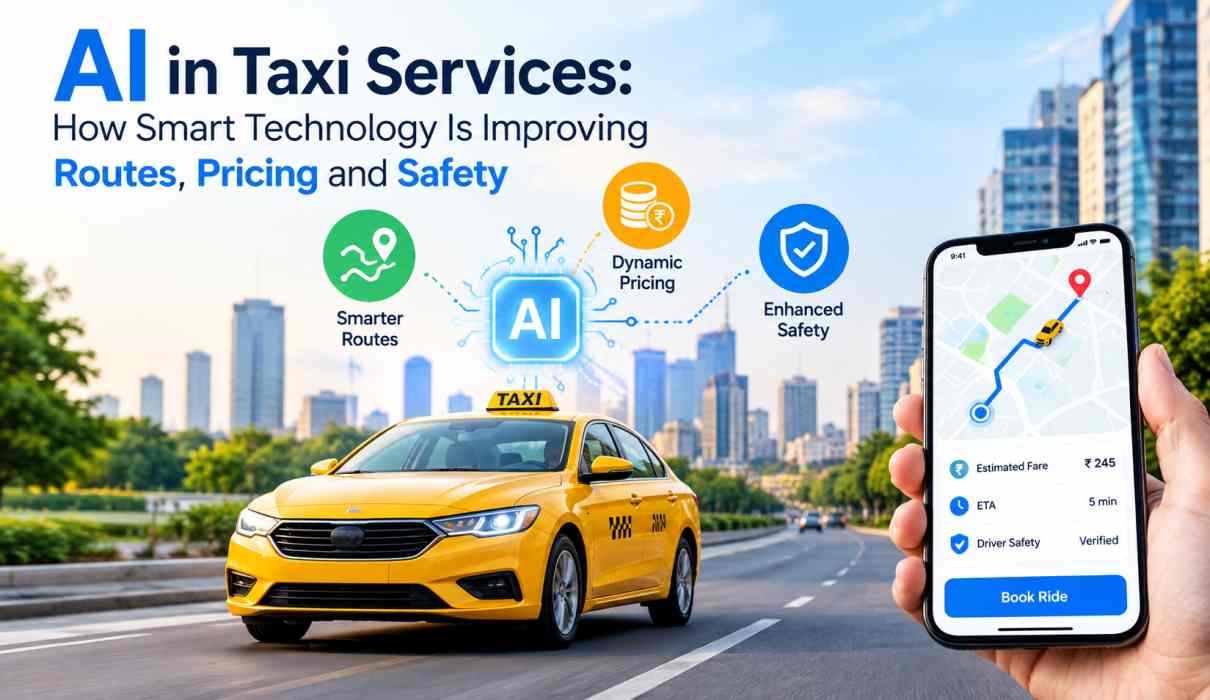
AI in Taxi Services: How Smart Technology Is Improving Routes, Pricing and Safety
The taxi industry is changing rapidly as artificial intelligence (AI) becomes part of everyday transportation. From predicting traffic and selecting faster routes to improving fare calculations and passenger safety, AI in taxi services is helping taxi companies and ride-hailing platforms create smarter and more efficient travel experiences.
In 2026, passengers expect more than simply getting from one location to another. They want accurate pickup times, transparent pricing, safer journeys, convenient booking, and reliable service. At the same time, taxi operators need to reduce fuel and maintenance costs, manage drivers efficiently, and respond quickly to changing demand.
AI can help address many of these challenges by analyzing large amounts of information and making predictions in real time.
But what exactly is AI changing in the taxi industry? And how does smart technology benefit passengers, drivers, and taxi businesses?
Let’s explore the major ways AI is transforming modern taxi services.
What Is AI in Taxi Services?
AI in taxi services refers to the use of artificial intelligence, machine learning, predictive analytics, computer vision, and related technologies to improve transportation operations.
AI systems can analyze information such as:
- Traffic conditions
- Passenger demand
- Pickup and drop-off locations
- Weather conditions
- Historical trip data
- Driver availability
- Travel times
- Road conditions
- Vehicle performance
- Booking patterns
The technology can then use this information to make predictions or automate decisions.
For example, an AI-powered taxi platform may predict that demand will increase near an airport after a flight arrives. It can then help position available drivers nearby, reducing passenger waiting times.
This combination of real-time information and predictive technology is making taxi services increasingly responsive.
1. AI Is Making Taxi Routes Smarter
One of the most visible applications of AI in transportation is route optimization.
Traditional navigation systems generally calculate routes using available road information. AI-powered systems can go further by analyzing historical and real-time data to estimate how traffic may change during a journey.
For example, an AI system can consider:
- Current traffic congestion
- Historical traffic patterns
- Road closures
- Accidents
- Weather
- Construction activity
- Time of day
- Expected traffic conditions
Instead of simply identifying the shortest distance, AI can help identify a route that may provide a better overall travel time.
Why does route optimization matter?
Better routes can benefit both passengers and drivers.
Passengers may experience:
- Shorter journeys
- More predictable arrival times
- Fewer delays
- Reduced travel stress
For drivers and taxi operators, optimized routes can potentially mean:
- Lower fuel consumption
- More completed trips
- Reduced idle time
- Better vehicle utilization
In busy cities, even small improvements in routing can make a significant difference when multiplied across thousands of daily journeys.
2. AI Helps Predict Taxi Demand
Another important application of AI is demand forecasting.
Taxi demand does not remain constant throughout the day. It can change according to commuting hours, weather, holidays, sporting events, concerts, flight schedules, and other local factors.
AI can study historical booking data and current conditions to predict where demand is likely to increase.
For example, a taxi platform may identify higher demand around:
- Airports
- Railway stations
- Business districts
- Shopping areas
- Hotels
- Tourist attractions
- Entertainment venues
Drivers can potentially use these insights to position themselves closer to areas where passengers are likely to request rides.
This creates a more efficient connection between supply and demand.
For passengers, better demand prediction can mean greater vehicle availability. For drivers, it can reduce the amount of time spent waiting for the next booking.
3. Smarter Pricing Through AI
Pricing is another area where technology is influencing taxi services.
AI can analyze multiple factors to help taxi platforms understand changing demand and operational conditions. Depending on the platform and local regulations, these factors can include booking volume, driver availability, location, time, and traffic conditions.
This can contribute to more responsive pricing models.
However, AI-powered pricing should not simply mean higher fares during busy periods. Transparent communication is important. Passengers should be able to understand the fare structure before confirming a trip.
Taxi companies can also use AI for fare estimation, helping passengers receive an estimated price before booking.
Accurate estimates can improve customer confidence and reduce misunderstandings between passengers and drivers.
4. AI Is Improving Passenger Safety
Safety is one of the most important areas where AI can support taxi services.
Modern taxi platforms can combine AI with GPS, smartphones, vehicle sensors, and other technologies to monitor trips and identify unusual situations.
For example, AI systems may identify patterns such as:
- Unexpected route deviations
- Unusual stops
- Extended stationary periods
- Sudden changes in vehicle movement
- Potentially abnormal trip behavior
If a system detects something that requires attention, the platform may trigger an alert or provide additional information to a support or safety team.
AI can also support driver monitoring technologies. Depending on the vehicle and system, computer vision can potentially identify signs of distracted or fatigued driving.
These technologies are not a replacement for human judgment, emergency services, or responsible driving. Instead, they can provide additional tools for identifying potential risks.
5. AI-Powered Driver Assistance
AI is also becoming increasingly useful for taxi drivers.
Drivers spend many hours on the road, often in challenging traffic conditions. Smart technology can provide assistance by processing information that would otherwise require constant manual attention.
AI-powered driver assistance can potentially help with:
- Traffic alerts
- Route recommendations
- Navigation
- Parking information
- Driver alerts
- Vehicle diagnostics
- Trip planning
Some advanced systems use computer vision and sensors to identify objects, lane markings, pedestrians, and other road users.
The objective is to provide drivers with additional information and assistance while keeping the driver responsible for controlling the vehicle.
6. AI Can Improve Taxi Fleet Management
For taxi companies operating multiple vehicles, managing a fleet can be complicated.
Operators need to know:
- Which vehicles are available
- Which vehicles are being used
- When vehicles require maintenance
- Where demand is increasing
- How efficiently vehicles are operating
- How much fuel or energy vehicles are consuming
AI can bring these data points together and help fleet managers make faster decisions.
For example, predictive maintenance systems can analyze vehicle data to identify signs that a component may require inspection or servicing.
Instead of waiting for a vehicle problem to occur, operators can potentially schedule maintenance earlier.
This can reduce unexpected downtime and help keep more vehicles available for passengers.
7. AI and Electric Taxi Fleets
The growth of electric vehicles is creating another opportunity for AI in taxi services.
Electric taxi operators need to manage charging carefully because a vehicle cannot operate efficiently if its battery is too low.
AI can help analyze:
- Battery levels
- Driving patterns
- Trip distances
- Charging station availability
- Expected demand
- Charging times
An intelligent fleet-management system could recommend when and where a vehicle should charge while considering upcoming bookings.
This can help operators balance passenger demand with charging requirements.
As electric taxis become more common, AI-based energy management may become an increasingly important part of taxi operations.
8. Faster and More Convenient Taxi Booking
AI is also changing the booking experience.
Instead of relying entirely on manual searches and fixed processes, modern taxi applications can use intelligent systems to understand passenger requests and improve booking recommendations.
AI-powered virtual assistants can potentially help passengers with questions such as:
- How long will my taxi take to arrive?
- What is the estimated fare?
- Where is my driver?
- Which vehicle is assigned to me?
- Can I change my destination?
- What should I do if I leave an item in the vehicle?
Natural language technology can make these interactions more conversational.
For taxi businesses, automated customer support can also handle routine questions, allowing human support teams to focus on more complicated issues.
9. AI Helps Reduce Waiting Times
Waiting for a taxi can be frustrating, particularly during busy periods.
AI can help reduce waiting times by matching passengers with available drivers more efficiently.
The system can consider:
- Driver location
- Passenger location
- Estimated arrival time
- Traffic
- Driver availability
- Vehicle type
- Current demand
Rather than simply assigning the closest vehicle, an AI-powered system can consider multiple variables to identify a practical match.
This can improve fleet utilization while giving passengers more accurate pickup estimates.
10. Better Customer Experience Through Personalization
AI can also help taxi companies understand customer preferences.
For example, with appropriate consent and privacy safeguards, platforms may use previous booking patterns to make relevant service suggestions.
A passenger who frequently books airport transfers might receive easier access to airport booking options. A business traveler may find corporate travel features more convenient.
Personalization should be implemented carefully. Taxi companies need to protect customer information and provide clear choices about how personal data is collected and used.
Trust remains essential as transportation becomes more technology-driven.
Challenges of Using AI in Taxi Services
Although AI offers many benefits, it also creates challenges.
Data Privacy
Taxi applications can process sensitive information, including location data, trip history, payment information, and contact details.
Companies must protect this information through appropriate security measures and comply with applicable privacy laws.
Algorithmic Errors
AI systems are not perfect. Incorrect predictions can result from incomplete data, unusual events, technical problems, or changing travel patterns.
Human oversight remains important.
Technology Costs
Developing and maintaining AI systems can require significant investment in software, infrastructure, cybersecurity, sensors, and employee training.
Smaller taxi operators may therefore need affordable technology solutions rather than complex systems designed only for large platforms.
Driver Acceptance
Drivers need to understand how AI-based systems affect their work.
Transparent communication, training, and accessible support can help drivers adapt to new technology.
What Is the Future of AI in Taxi Services?
The future of AI in taxi services is likely to involve increasingly connected transportation systems.
AI may become more closely integrated with:
- Electric vehicles
- Smart traffic systems
- Connected vehicles
- Digital payment systems
- Predictive maintenance
- Advanced driver assistance
- Automated customer service
- Fleet management platforms
Autonomous vehicles are also frequently discussed as a future development in transportation. However, widespread autonomous taxi adoption depends on technological readiness, regulation, infrastructure, safety validation, and public acceptance.
For the foreseeable future, AI is likely to work primarily as an intelligent support system for passengers, drivers, and taxi operators.
Final Thoughts
AI is changing taxi services from a simple point-to-point transportation model into a more connected and data-driven industry.
From AI route optimization and demand forecasting to safety monitoring, predictive maintenance, smarter fleet management, and personalized booking experiences, intelligent technology can improve many parts of the taxi journey.
For passengers, the goal is a more convenient, predictable, and potentially safer experience. For drivers, AI can provide useful information and help reduce inefficient driving and waiting time. For taxi businesses, it can provide better tools for managing vehicles, demand, costs, and customer service.
However, successful AI adoption requires more than technology. Privacy, transparency, cybersecurity, human oversight, and responsible implementation will remain essential.
As taxi services continue evolving in 2026 and beyond, AI is likely to become an increasingly important part of how people book, manage, and experience urban transportation.
Frequently Asked Questions About AI in Taxi Services
How is AI used in taxi services?
AI is used for route optimization, demand forecasting, fare estimation, driver assistance, safety monitoring, fleet management, predictive maintenance, customer support, and personalized booking experiences.
Can AI reduce taxi waiting times?
Yes. AI can analyze driver locations, traffic conditions, passenger demand, and estimated arrival times to help platforms match passengers with available vehicles more efficiently.
How does AI improve taxi safety?
AI can support safety by identifying unusual trip patterns, monitoring certain vehicle or driving signals, providing route information, and supporting driver-assistance technologies.
Does AI make taxi fares more expensive?
Not necessarily. AI can support different pricing and fare-estimation models. Actual fares depend on the taxi provider, local regulations, demand, distance, vehicle type, and other factors.
Can AI help electric taxi companies?
Yes. AI can help electric taxi operators manage charging schedules, battery levels, vehicle availability, expected demand, and fleet utilization.
Will AI replace taxi drivers?
AI can automate or assist with some transportation tasks, but AI technology does not automatically mean that taxi drivers will be replaced. The pace and extent of automation will depend on technology, regulation, economics, infrastructure, and consumer adoption.