
 By
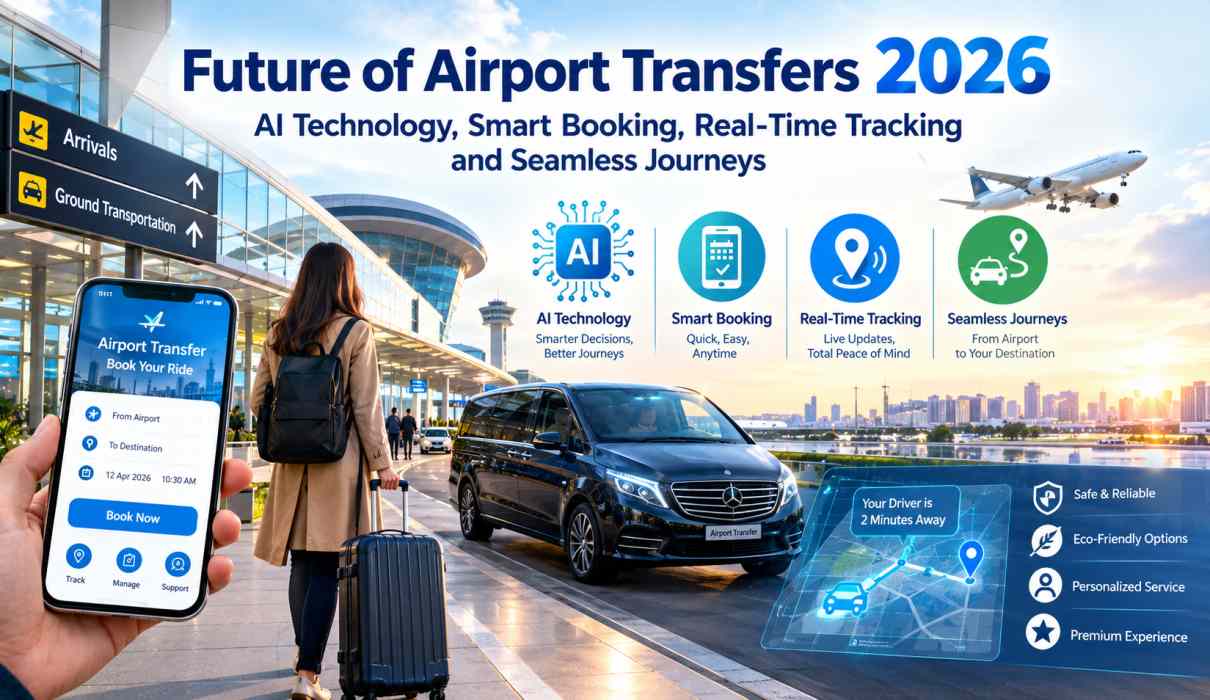
Future of Airport Transfers 2026: AI Technology, Smart Booking, Real-Time Tracking and Seamless Journeys
Airport transfers are becoming an increasingly important part of the modern travel experience. What was once a simple journey from an airport to a hotel, home, office or tourist destination is now evolving into a technology-driven mobility service. In 2026, travelers expect airport transportation to be convenient, reliable, transparent, personalized and easy to manage from a smartphone.
The growth of artificial intelligence (AI), smart booking platforms, real-time flight tracking, digital payments, connected vehicles and sustainable transportation is changing how passengers move after landing. Airports themselves are also becoming more digitally connected. SITA reports that 63% of airports plan to increase IT spending in 2026, while 60% are already using AI for passenger-flow management.
At the same time, travelers increasingly want their smartphones to manage different parts of their journey. IATA’s 2025 Global Passenger Survey found that 78% of passengers wanted a smartphone combining digital wallet, digital passport and loyalty functions for booking, payment and airport processes.
These developments point toward a future where airport transfers become more connected to the entire travel journey.
1. AI Is Transforming Airport Transfer Services
Artificial intelligence is one of the most important technologies influencing airport transportation in 2026. AI can analyze large amounts of information and help transfer providers make faster and more informed decisions.
For airport transfer companies, AI can support:
- Vehicle scheduling
- Driver allocation
- Route optimization
- Traffic prediction
- Customer communication
- Demand forecasting
- Flight monitoring
- Pricing management
- Fleet maintenance
- Customer-service automation
Instead of relying entirely on fixed schedules, intelligent systems can respond to changing travel conditions. If a flight is delayed, an AI-enabled platform can potentially identify the change and adjust the vehicle schedule accordingly.
The wider aviation industry is also moving toward greater use of AI. SITA reports that 73% of airports plan to invest in AI for prediction and automation, with applications including passenger flow, cybersecurity and aircraft turnaround.
For passengers, the benefit is simple: fewer unnecessary delays and a smoother connection between the airport and final destination.
2. Smart Booking Will Become the Standard
Traditional airport transfer booking often requires passengers to select a date, time, vehicle and pickup location manually. Smart booking systems are changing this process.
Modern platforms can connect booking information with flight details, passenger preferences and destination information. Travelers may increasingly be able to enter their flight number and destination and receive an automatically suggested pickup plan.
Smart booking platforms can also make it easier to select:
- Private airport transfers
- Executive cars
- Shared transportation
- Electric vehicles
- Family vehicles
- Accessible transportation
- Minibuses and larger group vehicles
- Child-seat options
- Business travel services
Mobile-first booking is particularly important. IATA reports that passengers are increasingly using smartphones for booking, payments, check-in and other stages of the travel journey.
As mobile technology becomes more integrated, travelers can expect airport transfer reservations to become faster and more personalized.
3. Real-Time Flight Tracking Improves Reliability
One of the biggest developments in airport transfers is real-time flight tracking.
A scheduled pickup time does not always match the actual arrival of an aircraft. Flights can arrive early, experience delays, change gates or be affected by weather and airport congestion.
Real-time flight tracking allows transfer companies to monitor these changes and adjust operations.
For example, if a flight is delayed by 45 minutes, the transfer provider can potentially adjust the driver’s arrival time instead of requiring the passenger to make a new booking. This can reduce unnecessary waiting and improve vehicle utilization.
Flight tracking can also help coordinate airport pickups during busy periods. When combined with traffic information, airport congestion data and driver-location information, it can create a much more responsive transfer system.
This type of real-time coordination reflects a wider transformation in aviation. SITA notes that airport performance increasingly depends on real-time coordination and the sharing of operational data across systems.
4. Seamless Airport-to-Destination Journeys
The future of airport transportation is not simply about moving passengers from Point A to Point B. It is about creating a seamless journey.
Passengers may increasingly expect one connected experience covering:
Flight booking → airport arrival → baggage → transfer → hotel → local transportation
This is particularly important for international travelers who may already be managing multiple digital documents, payments, reservations and travel applications.
SITA has highlighted the importance of collaboration between airports, airlines, rail operators, cities and other transport providers to reduce friction at transfer points.
Airport transfer providers can become an important part of this connected mobility ecosystem. A traveler could potentially receive transfer information together with flight and hotel information, reducing the need to manage multiple disconnected services.
5. Mobile Apps and Digital Payments
Smartphones are becoming central to modern travel, and airport transfers are following the same direction.
A modern airport transfer app or mobile-friendly platform can allow passengers to:
- Book a vehicle
- Select a pickup location
- Pay digitally
- Receive driver information
- Track the vehicle
- Receive flight updates
- Contact customer support
- Modify reservations
- Access booking confirmations
- Share journey details
Digital wallets are also becoming more popular. IATA reported that digital-wallet usage among surveyed travelers increased from 20% in 2024 to 28% in 2025.
For international travelers, digital payments can be particularly useful because they reduce the need to carry local currency or handle cash during a busy airport arrival.
6. Premium and Personalized Airport Transfers
Not every traveler has the same transportation requirements. Business travelers may prioritize punctuality and privacy, while families may need larger vehicles, luggage space and child seats.
The future of airport transfers is therefore expected to become increasingly personalized.
Transfer companies may offer customized options based on:
- Number of passengers
- Amount of luggage
- Travel purpose
- Preferred vehicle type
- Accessibility requirements
- Pickup preferences
- Budget
- Corporate travel policies
- Comfort expectations
Premium airport transfers can include executive vehicles, professional chauffeurs, meet-and-greet services and personalized assistance.
This trend also fits into the wider movement toward more personalized passenger experiences. IATA notes that passengers increasingly expect travel experiences to become more seamless, digital and personalized.
7. Electric and Sustainable Airport Transfers
Sustainability is another major trend shaping airport transportation.
Airport transfer companies are increasingly considering electric and hybrid vehicles as part of their fleet strategies. Electric vehicles can help reduce tailpipe emissions and noise, particularly in urban areas.
Future airport transfer fleets may include:
- Battery-electric cars
- Hybrid vehicles
- Electric vans
- Low-emission minibuses
- Renewable-energy charging infrastructure
However, sustainable transportation is not limited to replacing gasoline or diesel vehicles. Smart route planning can also reduce unnecessary mileage, while predictive scheduling can improve vehicle utilization.
Airports are also focusing on sustainability and operational efficiency. SITA reports that 75% of airports use building-management systems to monitor and optimize terminal energy use, illustrating the wider shift toward technology-supported efficiency.
For transfer companies, sustainability can therefore become a combination of cleaner vehicles, smarter routing and better fleet management.
8. Real-Time Vehicle Tracking and Passenger Safety
Passengers increasingly want visibility after making a transportation booking.
Real-time vehicle tracking can show passengers:
- Where their vehicle is
- Estimated arrival time
- Driver details
- Vehicle information
- Pickup instructions
- Journey progress
This can be especially useful at large international airports where passengers may have difficulty identifying the correct pickup zone.
Tracking technology can also support operational safety. Fleet managers can monitor vehicle locations, identify unusual delays and communicate with drivers when necessary.
For corporate travelers, tracking and digital journey records may also support travel-management and duty-of-care processes.
9. Better Handling of Luggage and Transfers
Luggage is one of the areas where technology can make airport journeys more convenient.
Transfer passengers frequently move between aircraft, terminals, vehicles and hotels. Technology that improves baggage visibility can therefore have an indirect impact on ground transportation.
SITA’s 2026 Baggage IT Insights reported that mishandled baggage fell 23% in 2025, while transfers remained a major source of baggage mishandling.
As baggage tracking becomes more sophisticated, airport transfer services could eventually become more closely connected to luggage status.
For example, a transfer provider could potentially receive updated information about a passenger’s arrival and baggage situation, allowing pickup coordination to become more flexible.
10. AI Chatbots and Automated Customer Support
Customer service is another area where AI is making a difference.
Travelers may encounter questions about pickup points, delays, cancellations, payment, luggage capacity or vehicle types. AI-powered customer-service systems can provide immediate answers to many routine questions.
A chatbot can potentially help passengers:
- Confirm a reservation
- Locate a pickup point
- Check vehicle status
- Change booking information
- Understand cancellation policies
- Request assistance
- Find answers to common questions
Deloitte’s 2026 travel industry outlook found that nearly a quarter of travelers surveyed had used generative AI for trip planning in late 2025, roughly three times the level reported in 2022.
As travelers become more comfortable using AI, airport transfer services are likely to incorporate conversational technology more extensively.
11. Airport Transfers for Business Travel
Corporate transportation is another important area of growth.
Business travelers often have strict schedules and require reliable transportation between airports, offices, hotels, conference centers and other destinations.
Technology can make corporate airport transfers easier to manage through:
- Centralized booking
- Employee travel profiles
- Digital receipts
- Automated invoicing
- Flight monitoring
- Executive vehicles
- Multi-passenger bookings
- Travel-management integration
For companies, reliable airport transfers can reduce administrative work while providing employees with a more predictable travel experience.
12. Accessibility and Family-Friendly Transportation
Future airport transfers will also need to address diverse passenger requirements.
Families may require child seats and additional luggage capacity. Older travelers may benefit from assistance at pickup locations. Passengers with disabilities may require accessible vehicles and additional support.
Smart booking platforms can make these requirements easier to communicate before the journey begins.
Instead of arranging special assistance at the last moment, travelers can potentially select their needs during the original reservation process.
This creates a more inclusive and predictable transportation experience.
13. Cybersecurity and Data Privacy
Greater digital connectivity also introduces new responsibilities.
Airport transfer platforms may handle names, phone numbers, travel schedules, payment details, flight information and location data. Protecting this information is therefore essential.
The wider aviation industry is placing increasing emphasis on cybersecurity as digital identity, AI and connected systems expand. SITA identifies data coordination and security as important elements of aviation’s digital transformation.
Future airport transfer providers will need strong cybersecurity, secure payment systems, appropriate data handling and transparent privacy policies.
Convenience should not come at the expense of passenger trust.
14. What the Future of Airport Transfers Looks Like
The airport transfer of the future will be increasingly connected to the passenger’s complete travel journey.
A traveler could potentially book a flight, hotel and airport transfer through a connected digital platform. The transfer service could automatically monitor the flight, adjust the pickup time, provide driver information and send navigation instructions to the passenger’s smartphone.
The vehicle itself could become part of a connected mobility network, with real-time location information and smart fleet management.
AI could help optimize routes, predict demand and coordinate vehicles, while electric transportation could contribute to lower-emission ground mobility.
The biggest opportunity, however, may not come from any single technology. It will come from connecting different systems so that information can move smoothly between travelers, airports, airlines, transfer providers and other transportation services.
Conclusion
The future of airport transfers in 2026 is being shaped by AI technology, smart booking, real-time flight tracking, mobile payments, connected vehicles, sustainable transportation and personalized services.
Passengers increasingly expect transportation to be simple, transparent and digitally connected. Airport transfer companies that adopt modern technology can improve scheduling, communication, fleet efficiency and customer experiences.
At the same time, technology must be supported by reliable human service. Professional drivers, clear communication, safety, accessibility and customer support will remain essential.
The next generation of airport transfers will therefore combine artificial intelligence with human service, smart technology with sustainable mobility, and real-time information with personalized travel experiences.
As airports and the wider travel industry become increasingly connected, airport transfers will move beyond being a basic transportation service. They will become an important part of the seamless, intelligent and passenger-focused journey of the future.