
 By
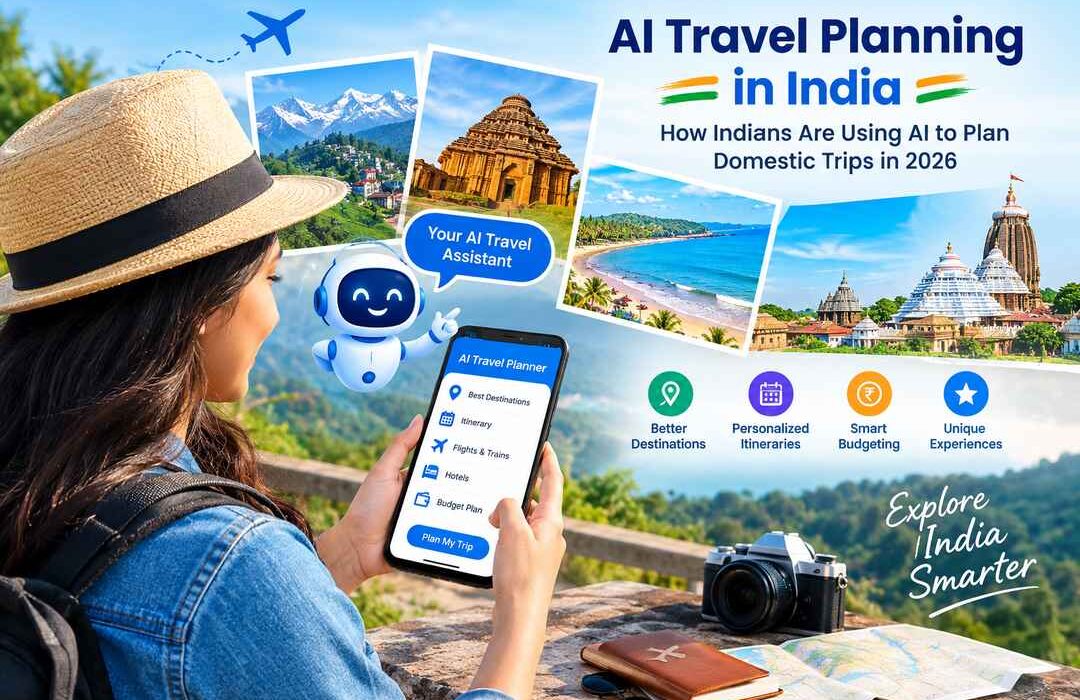
By AI Travel Planning in India: How Indians Are Using AI to Plan Domestic Trips in 2026
Planning a holiday in India has traditionally involved comparing destinations, checking weather, searching for hotels, estimating travel costs, reading reviews, and building an itinerary manually. In 2026, that process is changing rapidly. AI travel planning in India is becoming an increasingly popular way to discover destinations, organize trips, compare options, and create personalized travel plans.
The shift is particularly interesting because Indians are showing strong interest in domestic travel. According to the 2026 Allianz Partners Global Travel Confidence Index, 60% of Indian travellers surveyed preferred holidays within the country, while 82% said they had already used or planned to use AI to plan vacations. Allianz Partners
Another 2026 Agoda report found that 33% of Indian travellers surveyed already use AI for travel planning, while 68% said they were likely to use AI for their next trip. Agoda
These numbers point toward a major change in how people approach domestic travel in India. Instead of using AI only for inspiration, travellers are increasingly treating it as a digital travel assistant that can help with everything from destination discovery to itinerary planning.
So, how exactly are Indians using AI to plan domestic trips in 2026? And what does this mean for the future of travel?
What Is AI Travel Planning?
AI travel planning involves using artificial intelligence tools to research, organize, personalize, and manage different parts of a trip.
Traditional travel planning usually requires multiple searches. A traveller may search separately for destinations, hotels, restaurants, transportation, attractions, weather conditions, and activities.
AI can bring many of these tasks together.
For example, a traveller could ask an AI assistant:
“Plan a four-day family trip from Kolkata to Kerala in October with a moderate budget. Include comfortable hotels, sightseeing, local food, transportation, and some activities suitable for children.”
Instead of receiving a simple list of websites, the traveller can receive a structured starting point that considers several requirements at once.
The result may not always be perfect, but it can dramatically reduce the amount of initial research required.
Why AI Travel Planning Is Becoming Popular in India
Several factors are contributing to the growth of AI-powered travel planning.
First, Indian travellers are increasingly comfortable using digital services for research and bookings. Google research indicates that travellers in India use digital platforms extensively throughout the inspiration, research, planning, and booking journey, with Google and YouTube among the leading touchpoints. Google
Second, domestic tourism offers an enormous range of choices. India has mountains, beaches, forests, deserts, heritage cities, pilgrimage destinations, wildlife reserves, islands, hill stations, wellness retreats, and metropolitan experiences.
The challenge is no longer simply finding a destination. It is finding the right destination for a particular traveller.
AI can help narrow down those choices based on budget, interests, duration, season, travel companions, and preferred activities.
1. AI Helps Indians Discover New Domestic Destinations
One of the biggest advantages of AI is destination discovery.
A traveller who does not know where to go can describe their preferences instead of searching for a specific destination.
For example:
- “Suggest peaceful hill stations for a couple.”
- “Find budget-friendly destinations for a family trip.”
- “Where can I go for a three-day monsoon getaway?”
- “Suggest less crowded beach destinations in India.”
- “Which destinations are good for a solo trip from Delhi?”
AI can generate destination suggestions based on these preferences.
This could also encourage travellers to explore places beyond India’s most famous tourist destinations. Instead of repeatedly visiting the same popular cities, travellers can discover smaller towns, regional attractions, nature destinations, and experience-focused locations.
That aligns with the broader 2026 trend toward more personalized and experience-led travel.
2. AI Creates Personalized Travel Itineraries
Creating an itinerary is one of the most common uses of AI travel tools.
A good itinerary needs to balance sightseeing, transportation, meals, rest, and the traveller’s interests. Manually doing this can take hours.
AI can generate a preliminary itinerary in seconds.
For example, a traveller visiting Rajasthan could request a seven-day plan covering Jaipur, Jodhpur, and Udaipur, with preferences for heritage sites, local food, photography, and mid-range hotels.
The AI can organize the trip day by day.
Travellers can then refine the plan:
“Reduce the number of museums.”
“Add more local food experiences.”
“Keep afternoons free.”
“Make the itinerary suitable for senior citizens.”
This conversational approach makes itinerary planning more flexible.
3. AI Helps Travellers Plan According to Their Budget
Budget is one of the most important factors in domestic travel.
AI can help travellers create plans around a specific spending limit.
For example:
“Plan a five-day trip to Himachal Pradesh for two people under ₹40,000, excluding shopping.”
The system can help divide the estimated budget into categories such as:
- Transportation
- Accommodation
- Food
- Local travel
- Sightseeing
- Activities
- Emergency expenses
This makes it easier for travellers to understand whether their preferred itinerary is realistic.
However, AI-generated costs should be treated as estimates rather than guaranteed prices. Hotel rates, transportation fares, attraction fees, and seasonal prices can change frequently.
4. AI Makes Travel Planning More Conversational
Traditional search requires users to know what they are looking for.
AI changes that dynamic.
Instead of entering several keywords, users can describe their situation naturally.
A traveller could say:
“I have a long weekend in August, I live in Mumbai, I don’t want to spend too much time travelling, and I prefer nature and good food. Where should I go?”
This type of conversational search can be particularly useful for people who are undecided.
AI can ask follow-up questions or refine recommendations based on additional information.
This makes AI trip planning in India feel more like talking to a travel consultant than using a conventional search engine.
5. AI Helps With Family Travel
Family holidays often involve more complicated requirements.
Parents may need child-friendly activities, comfortable accommodation, convenient transportation, and a manageable schedule. Travelling with grandparents may add additional requirements related to walking distances, accessibility, and rest periods.
AI can incorporate these preferences into an itinerary.
For example:
“Create a six-day Kerala itinerary for a family with two children and grandparents. Avoid long road journeys and include relaxed sightseeing.”
This can help create a more practical starting point than a generic destination guide.
In 2026, family and multi-generational travel remain important parts of the Indian travel market. Skyscanner’s 2026 Indian traveller research found that 41% of surveyed travellers planned to travel with family, including multi-generational journeys. Skyscanner
6. AI Helps Solo Travellers Plan More Confidently
Solo travel requires a different type of planning.
Travellers may want information about transportation, neighborhoods, activities, safety considerations, and suitable accommodation.
AI can organize these requirements into one research process.
A solo traveller could ask:
“Create a four-day itinerary for a first-time solo traveller in Rajasthan. Prioritize cultural experiences, easy transportation, and well-connected accommodation areas.”
AI can then provide suggestions that the traveller can investigate further.
Importantly, AI should not be treated as the final authority on personal safety. Travellers should verify current local conditions, official advisories, transportation information, and accommodation reviews before making decisions.
7. AI Helps Find Experiences, Not Just Places
Modern travel is increasingly experience-focused.
People are not always travelling simply to “see” a destination. They may travel for food, festivals, wellness, hiking, photography, music, sports, shopping, wildlife, or cultural experiences.
AI makes it easier to build trips around these interests.
For example:
“Plan a three-day trip focused entirely on Bengali food and heritage architecture.”
Or:
“Suggest a weekend destination near Bengaluru for hiking, local food, and photography.”
This changes the traditional destination-first approach into an interest-first travel planning model.
The traveller starts with what they want to experience and allows AI to suggest where and how to do it.
8. AI Can Help Compare Destinations
Choosing between destinations can be difficult.
For example, a traveller may be deciding between Goa and Kerala, Jaipur and Udaipur, or Manali and Mussoorie.
AI can create a comparison based on factors such as:
- Travel time
- Approximate budget
- Weather
- Activities
- Family suitability
- Food
- Accommodation
- Crowds
- Local transportation
This doesn’t necessarily replace independent research, but it can make the decision-making process faster.
9. AI Supports Weather and Seasonal Planning
Timing can significantly affect a domestic holiday.
Travellers need to consider monsoon conditions, summer temperatures, winter weather, snowfall, festivals, peak tourist seasons, and local events.
AI can help users understand which destinations may suit their preferred travel period.
For example:
“Where should I travel in India in December if I want pleasant weather, cultural experiences, and fewer extreme temperatures?”
AI can generate possibilities, but travellers should verify current weather forecasts and local conditions closer to departure.
This is particularly important because climate and extreme-weather risks are becoming more relevant to travel decisions. The 2026 Allianz survey found that 84% of Indian travellers surveyed were concerned about extreme weather and environmental risks while travelling. Allianz Partners
10. AI Can Help Optimize Travel Time
A common problem with travel itineraries is trying to fit too many attractions into one day.
AI can help organize activities geographically and logically.
For example, instead of recommending attractions scattered across an entire city on the same day, an intelligent itinerary can group nearby places together.
It can also suggest leaving buffer time between activities.
This is an area where AI travel planning is developing rapidly. Recent research on AI travel planning in India highlights the challenge of accounting for real-world uncertainties such as transportation delays and crowd fluctuations. arXiv
In other words, the best AI itinerary is not necessarily the one containing the most attractions. It is the one that remains practical when real-world delays occur.
11. AI Is Helping Create More Flexible Travel Plans
Travel plans often change.
A train may be delayed. A hotel may become unavailable. Heavy rain may affect sightseeing. A traveller may decide to spend an extra day in one location.
AI can help restructure an itinerary based on these changes.
A user could say:
“Tomorrow’s outdoor activities are cancelled because of rain. Rearrange my itinerary using indoor attractions.”
Or:
“I want to stay one additional night. Adjust the remaining three days.”
This ability to adapt could become one of the most valuable features of AI travel assistants.
12. AI and the Rise of Smarter Domestic Travel
The growth of AI travel planning is happening alongside strong interest in domestic tourism.
The 2026 Allianz report found that 60% of surveyed Indian travellers preferred holidays within India. Allianz Partners
Meanwhile, Agoda’s 2026 data suggests Indian travellers are increasingly interested in shorter, meaningful getaways, with an expected average trip duration of four to seven days. NewsVoir
This combination creates an ideal environment for AI-powered planning.
When travellers have limited time, they need to use that time efficiently. AI can help them quickly compare destinations, create itineraries, estimate budgets, and identify experiences.
Benefits of Using AI for Domestic Travel Planning
The major advantages of AI travel planning include:
- Saves time: AI can organize initial research quickly.
- Personalized suggestions: Recommendations can reflect individual interests and budgets.
- Easy itinerary creation: Day-by-day plans can be generated within seconds.
- Conversational search: Users can explain their requirements naturally.
- Destination discovery: AI can suggest places travellers may not have considered.
- Budget assistance: Estimated expenses can help users plan realistically.
- Flexible planning: Itineraries can be modified when circumstances change.
- Convenience: Multiple planning tasks can be brought into one conversation.
What Are the Limitations of AI Travel Planning?
Despite its advantages, AI is not a replacement for reliable travel research.
AI systems can sometimes provide outdated, incomplete, or incorrect information. A recommended hotel may have changed its policies, an attraction may have different opening hours, or transportation schedules may have changed.
There is also a growing trust question. Agoda’s 2026 research found that 53% of Indian travellers surveyed said they trusted AI-generated information, while 12% expressed distrust. NewsVoir
This suggests that many travellers are willing to use AI, but they may still want to verify important information.
For important decisions, travellers should cross-check:
- Official attraction websites
- Hotel websites
- Transport operators
- Government travel advisories
- Current weather forecasts
- Recent traveller reviews
- Cancellation and refund policies
AI should be viewed as a travel planning assistant, not an infallible travel authority.
How to Use AI Effectively for Your Next Indian Trip
To get better results, travellers should give AI detailed instructions.
Instead of asking:
“Plan a trip to Kerala.”
Try:
“Plan a five-day Kerala trip for two adults in November with a moderate budget. We prefer nature, local food, relaxed sightseeing, and boutique accommodation. Avoid overly packed schedules and keep daily travel under four hours where possible.”
The more relevant information you provide, the more useful the initial itinerary is likely to be.
Travellers can also ask AI to create alternatives:
“Give me a budget version, a comfortable version, and a premium version.”
This makes comparison easier.
The Future of AI Travel Planning in India
AI travel planning is likely to become more sophisticated as technology improves.
Future systems may combine conversational AI with live transportation information, hotel availability, maps, weather, events, reviews, pricing, and personalized preferences.
The next generation of AI travel assistants may not simply answer questions. They could potentially act as end-to-end travel companions, helping users discover destinations, create plans, adjust schedules, and manage changing circumstances.
The emergence of AI-powered travel services in India already points in this direction. For example, Swiggy’s 2026 travel initiative combines AI with human concierge support to provide assistance across parts of the travel journey. The Times of India
The broader trend is clear: AI is moving from a novelty to a practical travel-planning tool.
Conclusion
AI travel planning in India is changing how people plan domestic holidays in 2026. Instead of spending hours searching separately for destinations, hotels, attractions, transportation, and activities, travellers can use AI to bring many of these tasks together.
From personalized itineraries and budget planning to destination discovery and flexible schedules, AI can make domestic travel research faster and more convenient.
The trend is especially significant in India because domestic travel remains strong and travellers are increasingly looking for personalized, meaningful experiences. At the same time, high adoption of AI suggests that digital travel assistants will play an increasingly important role in the way people discover and plan holidays.
However, the smartest approach is not to let AI make every decision. Use it to generate ideas, organize information, compare options, and build a practical starting plan. Then verify important details through reliable and current sources before booking.
In 2026, the future of travel planning in India is becoming increasingly personalized, conversational, flexible, and AI-assisted. The result could be a simpler way for travellers to turn a basic idea—”I want to take a trip”—into a realistic and personalized journey.
::: Sources